The tools and systems behind the products, rather than the products themselves. Each one carries its own evidence: something live, a diagram, or code you can read.
I-01Live
Zentauri UI
React + Tailwind v4, token-first, axe-core in CI
A component library published to npm as @zentauri-ui/zentauri-components. The interesting parts are the API surface — how much a consumer has to know to use a component correctly — and keeping motion optional without leaking implementation detail into props. Accessibility is exercised in CI rather than documented: 46 dedicated tests pair axe-core audits with keyboard interaction across every interactive and compound component, each asserting zero violations.
CopyButton is one of the library's simplest components, which is why it shows the API decision clearly: the base props carry a render seam, and the type the consumer actually receives has it removed.
ts
export type CopyButtonIconRenderer = (state: { copied: boolean; copyIcon: ReactNode; copiedIcon: ReactNode;}) => ReactNode;export interface CopyButtonBaseProps extends Omit<ComponentPropsWithRef<'button'>, 'value' | 'onCopy'> { /** Text written to the clipboard when the button is pressed. */ value: string; /** Milliseconds the copied state stays active. `0` keeps it until re-copied. */ timeout?: number; /** Label shown (and used for `aria-label`) in the idle state. */ label?: string; /** Label shown (and used for `aria-label`) after a successful copy. */ copiedLabel?: string; /** Overrides how the icon region renders; the animated entry uses this. */ renderIcon?: CopyButtonIconRenderer;}export type CopyButtonProps = Omit<CopyButtonBaseProps, 'renderIcon'>;
Published type declarations, verifiable with `npm pack @zentauri-ui/zentauri-components`.
L8Extending `ComponentPropsWithRef<'button'>` and omitting only the two props it redefines means `type`, `disabled`, `aria-*` and `ref` all keep working. The component adds behaviour without taking anything away.
L12`timeout` documents its own edge case in the type, rather than leaving `0` to be discovered. Every prop here carries a doc comment, which is what makes the surface usable without reading the source.
L21The last line is the whole decision. `renderIcon` exists so the animated build can swap static icons for motion ones — but it is implementation detail, so the exported `CopyButtonProps` subtracts it. A consumer cannot reach the seam, and the seam can change without a breaking release.
The claim "motion is optional" is usually a prop that ships the animation library to everyone anyway. Here it is enforced by module boundary: `framer-motion` is imported in the animated subpath and nowhere else.
ts
// dist/ui/copy-button/animated/types.d.tsimport type { Transition } from 'framer-motion';import type { CopyButtonProps } from '../types';export type CopyButtonAnimation = 'swap' | 'pop' | 'fade';export type CopyButtonAnimatedProps = CopyButtonProps & { animation?: CopyButtonAnimation;};// dist/ui/copy-button/index.d.ts — the static entryexport { CopyButton } from './copy-button';export type { CopyButtonProps } from './types';// dist/ui/copy-button/animated/index.d.ts — opt in, and only thenexport { CopyButtonAnimated } from './copy-button-animated';export { copyButtonAnimationPresets } from './animations';
Published type declarations. The static and animated barrels are separate module paths.
L2`framer-motion` appears in the animated subpath's types and not in the static one. Import `ui/copy-button` and the animation library is not in your graph at all — the cost follows the import, not the install.
L5Three named presets rather than an open transition object. The consumer picks an intent; the library owns the timing. This is the same reason this site exposes `--ease-*` tokens instead of raw cubic-béziers.
L7The animated props are the static props *plus one*. There is no second API to learn and no divergence to maintain: swapping `CopyButton` for `CopyButtonAnimated` is a one-word change at the call site.
I-02Code
Playwright automation suite
E2E, API, snapshot, a11y, link validation, auth flows
A test suite that covers end-to-end flows, API contracts, UI snapshots, accessibility checks, link validation, and authentication workflows. The goal was release confidence: making a green pipeline mean something specific rather than something vague.
Coverage layers
E2E
API
snapshot
a11y
link validation
auth flows
A gate that makes one green check mean one specific thing
this repository — tests/delete-the-canvas.mjs
The suite behind I-02 is not public, so here is the same discipline applied to this site, where you can read the whole file. This site's riskiest claim is that its 3D layer is removable without loss. That claim is a test, not a promise.
js
const html = readFileSync('dist/index.html', 'utf8');// 1. The scene is absent from the served HTML entirely.check('no <canvas> in served HTML', !/<canvas/i.test(html));check('no scene container in served HTML', !html.includes('data-scene-tier'));// 2. The fallback is unconditional, with one art plate per band.check('art fallback layer present', html.includes('art-plate'));check('an art plate per band', plates === 8, `found ${plates}`);// 3. The scene never reaches the critical path.check('scene not on the critical path', !criticalJs.includes('three'));check('scene is its own lazy chunk', sceneChunk !== undefined);// 4. Source-level: nothing in the scene tree can take focus.for (const file of readdirSync(SCENE_DIR)) { const src = readFileSync(join(SCENE_DIR, file), 'utf8'); check( `no focusable elements in ${file}`, !/tabIndex|<button|<a\s|onClick/.test(src), );}
Runs on every `pnpm verify`. The excerpt is the assertion block, lightly trimmed.
L5Asserting *absence* turned out to be stronger than the original plan, which only asked for `aria-hidden`. The scene renders null on the server, so a visitor with no JavaScript, no WebGL, or a `saveData` connection never receives the element at all.
L12Two separate budget facts, asserted separately: the 233KB scene chunk is allowed to be large precisely because this proves it is not on the critical path, which stayed at 2.4KB across three phases.
L16The source-level sweep is the part that catches the real failure mode. A canvas is easy to keep accessible on day one; the risk is interactivity slowly migrating into it over months. This fails the build the first time a `<button>` appears in the scene tree.
I-03Diagram
Multi-brand monorepo CMS
Next.js + Payload + PostgreSQL across brands
A CMS serving several brands from one monorepo. Shared primitives and per-brand overrides, so adding a brand is configuration rather than a fork. The measurable outcome was onboarding speed for a new brand and how much code stayed shared.
One repository, three deployables, one content platform
Every brand is the same application with different configuration. Adding one is a config entry and a theme, not a fork — which is the only reason the shared layer stays shared over time.
The design system, the CMS block definitions and the data layer are versioned together. A block added once becomes available to every brand in the same release.
One Payload schema with brand-scoped records, on one PostgreSQL instance. Editors work in a single admin rather than three, and a migration runs once.
The outcome that mattered was onboarding cost: standing up a new brand became a day's configuration, and the proportion of code that stayed shared is what kept maintenance flat as brands were added.
I-04Live
Orbit
WebGL n-body simulation with live telemetry
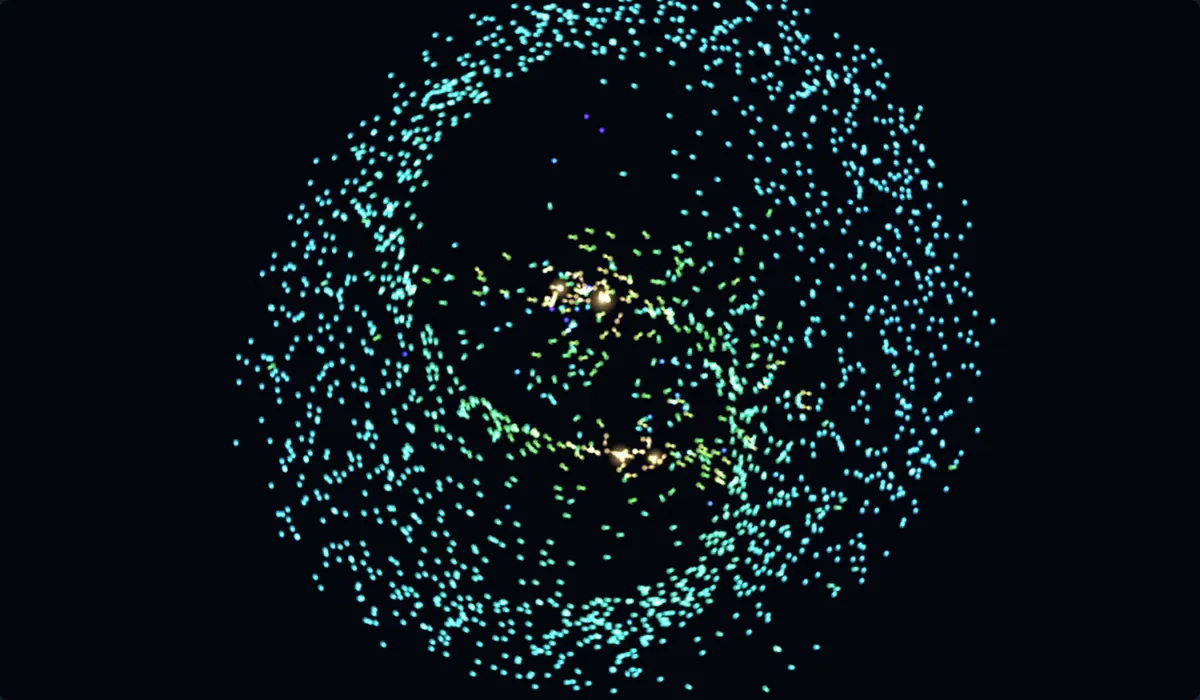
A gravitational simulation built for this site: four masses attracting each other pairwise, and two thousand massless test particles integrated against them with semi-implicit Euler and softened gravity. It reports its own frame time, particle count and device pixel ratio, halves its workload when it falls behind, stops entirely when off-screen or hidden, and never downloads at all below 1024px. It runs in WebGL not because two thousand particles demand a GPU, but because this site already loads three.js for its backdrop — so the simulation costs a few kilobytes of code instead of a second renderer.
FPS
—
Interval
—
Sim
—
Particles
2000
Masses
4
DPR
1.00
State
Nominal
What forms on screen: a broad disc of particles settles around the four masses at the centre, which show as bright gold points. Colour tracks speed — cool blue out on the wide slow orbits, warming to gold where a particle whips past a mass — and gaps open where orbits fall into resonance, so the disc is banded rather than uniform. Moving the pointer over the canvas adds a fifth, temporary attractor and pulls the nearby bands out of shape.
What forms on screen: a broad disc of particles settles around the four masses at the centre, which show as bright gold points. Colour tracks speed — cool blue out on the wide slow orbits, warming to gold where a particle whips past a mass — and gaps open where orbits fall into resonance, so the disc is banded rather than uniform. Moving the pointer over the canvas adds a fifth, temporary attractor and pulls the nearby bands out of shape.
Shown as a still below 1024px — the simulation is not downloaded on phones or tablets.
Categories of work delivered
Scope, not exhibits — these are the kinds of build this experience covers. The evidence is the four instruments above.